
China to EU vehicle approval matters because the same regulatory record must stay consistent across type approval, eCoC generation, IVI structures and registration-facing workflows.
Regulations
China to EU Vehicle Approval Requirements: What Exporting Manufacturers Should Expect
Learn what China-based manufacturers should expect when preparing for EU vehicle approval, structured conformity data and European market entry.
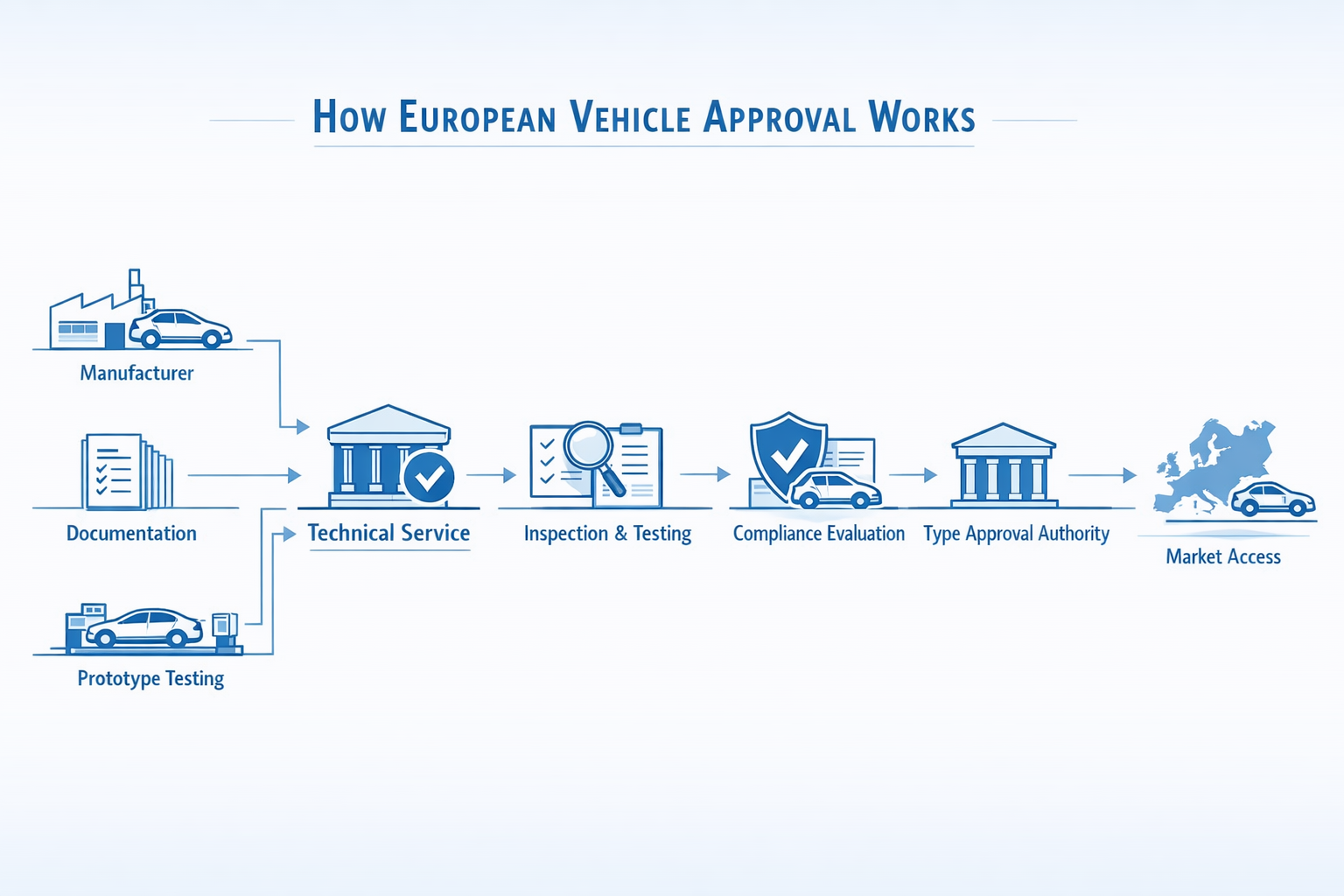
China to EU Vehicle Approval Requirements: What Exporting Manufacturers Should Expect
China-based manufacturers targeting the European market face more than an export documentation task. They face a new compliance environment with different approval assumptions, structured data expectations and downstream conformity requirements. The challenge is not only understanding the rules. It is preparing an internal operating model that can support them consistently.
That is why China-to-EU vehicle approval readiness is best approached as a system transition. The organization needs to connect product knowledge, approval interpretation, controlled data preparation and release accountability in a way that fits the European model.
Why the EU Environment Feels Different
The European market places strong emphasis on approved technical configuration, type approval logic and repeatable regulatory records. Manufacturers that are successful in other environments may still need to adapt their process because Europe expects a tighter connection between approval basis, structured data representation and conformity output.
That means export readiness cannot rely on commercial planning alone. It needs compliance planning that starts before final submission steps are considered.
What Exporting Manufacturers Need to Stabilize
Before preparing Europe-facing outputs, manufacturers should stabilize three things. First, the approved configuration model: which technical truth will be treated as authoritative. Second, the data model: how that truth is represented and controlled across systems. Third, the release model: who confirms that the final record is aligned, complete and ready for downstream use.
If one of those layers is weak, the export workflow may still move forward, but it will carry more operational risk than the organization can easily see.
Type Approval and Documentation Discipline
EU entry requires more than a document package. It requires confidence that the documentation, approval references and released technical values all describe the same approved vehicle. That sounds straightforward, but it becomes difficult when source systems evolved for another regulatory environment and do not yet map cleanly into EU-oriented controls.
Manufacturers should therefore review how approval evidence, technical records and conformity preparation are connected internally. The goal is not to create more paperwork. The goal is to reduce ambiguity before the record reaches a European workflow.
Why Structured Data Readiness Matters
Electronic conformity processes in Europe raise the importance of structured data. IVI records, eCoC preparation and downstream exchange expectations all benefit from machine-readable values that remain synchronized with approval references. Exporting manufacturers should view this as an opportunity to strengthen release quality rather than as a narrow formatting burden.
When structured data is weak, teams compensate with manual translation between systems. That usually slows the path to reliable EU readiness.
Common Risks in China-to-EU Preparation
One common risk is assuming that successful local certification patterns can be reused without architectural change. Another is relying too heavily on late-stage mapping between engineering records and EU-oriented outputs. A third is treating authority-facing conformity data as a downstream service issue instead of a source-governance issue.
These risks do not always surface immediately. They often become visible when the organization tries to scale beyond one product or one release cycle.
What a Strong Export-Readiness Model Looks Like
A strong model aligns product, approval, data and release decisions before the final output stage. Manufacturers should know which record is authoritative, how EU approval references are maintained, how validation confirms consistency and which team owns release. Once that foundation is stable, Europe-facing conformity work becomes much easier to repeat.
That is the real objective. Not just to enter the EU once, but to build a repeatable path for Europe-bound programs.
Frequently Asked Questions
Is China-to-EU readiness mainly about export documentation?
No. It is also about approval interpretation, structured data quality and release governance.
Why should China-based manufacturers care about IVI and eCoC?
Because these layers influence how approved vehicle data is prepared for European conformity workflows.
What should be stabilized first?
The approved configuration model, the structured data model and the release ownership model should be stabilized first.
SEO Support Layer
Why China to EU vehicle approval has become a strategic topic
China to EU vehicle approval is no longer only a technical label. It now sits at the center of vehicle compliance operations because eCoC issuance, IVI data structures, type approval discipline and registration-facing regulatory workflows all depend on the same trusted information model. For manufacturers, homologation teams and compliance specialists, the real challenge is not producing one isolated file. It is keeping the underlying regulatory record aligned, reviewable and reusable across approval, verification and downstream authority processes. This page extends the article with that broader operating context so the keyword is understood as part of a full compliance system, not as a standalone definition.
How China to EU vehicle approval connects to eCoC operations
China to EU vehicle approval matters because electronic conformity processes only work when the underlying regulatory record is stable. If teams treat eCoC as a final deliverable instead of a governed operating flow, approval references, structured data and validation logic drift apart. In practice, that creates avoidable rework, inconsistent authority submissions and a weaker audit trail. The stronger approach is to connect China to EU vehicle approval to the full operating model: source data, approval evidence, validation checkpoints, release controls and downstream registration readiness.
Type approval, IVI and verification in the same chain
A useful way to evaluate China to EU vehicle approval is to place it inside the full compliance chain. Vehicle type approval defines the approved technical configuration. IVI structures carry that configuration through systems in a machine-readable form. Verification controls then confirm that the same data remains consistent when it is used in conformity, registration and regulatory workflows. Looking at China to EU vehicle approval in isolation misses the fact that these layers depend on each other. The topic becomes operationally relevant only when approval, data structure and verification are managed as one continuous flow.
Why governance and system coordination are part of the keyword
Most problems around China to EU vehicle approval are not caused by one missing parameter. They come from fragmented ownership across engineering records, manufacturing systems, approval files and registration-facing datasets. That is why governance, synchronization and system coordination are not abstract process ideas. They are the mechanisms that keep the same regulatory truth intact across teams and systems. When those controls are weak, compliance reviews become slower, outputs become harder to trust and the distance between approval data and market-facing operations grows.
What teams should prepare next
For most organizations, the practical next step around China to EU vehicle approval is to map which systems generate the source data, which teams approve changes, which validation checks are required and which downstream process consumes the final record. Once that is visible, the topic stops being a narrow technical explanation and becomes part of a repeatable vehicle compliance workflow. That transition is critical when eCoC outputs, type approval references, IVI data handling and registration preparation all depend on the same controlled dataset.
Need help with vehicle compliance or eCoC processes?
Contact our team if you need help evaluating this topic at the level of product, process and rollout planning.
Frequently Asked Questions
Additional questions that connect the primary keyword in this article to eCoC, vehicle compliance and regulatory data operations.
Frequently Asked Questions
Reliable eCoC outputs depend on the technical and governance controls behind China to EU vehicle approval, not just on the final XML or document layer.
Manufacturers, homologation specialists, regulatory consultants, body builders and verification teams all depend on the operating context behind China to EU vehicle approval.
The main risk is data drift between systems, where approval records, structured datasets and downstream processes no longer represent the same vehicle configuration.
The main eCoC article, the vehicle compliance authority page, the IVI guide and the vehicle type approval guide should be read together as one topic cluster.
Related Guides
Curated internal guides that extend the same regulatory and operational topic cluster.
Regulations
Why Vehicle Approval Documentation Must Remain Consistent
Vehicle approval documentation must remain consistent across regulatory systems. Learn why documentation alignment is essential for automotive compliance.
Published: 7 March 2026
Read moreBody-Built Vehicles
Understanding Multistage Vehicle Approval in Europe
Learn how multistage vehicle approval works in Europe and how different manufacturers contribute to the compliance of specialized vehicles.
Published: 7 March 2026
Read moreTechnical Guides
Why Automotive Compliance Data Requires Continuous Validation
Automotive compliance data must be continuously validated to maintain regulatory integrity. Learn why validation processes are critical for vehicle compliance systems.
Published: 7 March 2026
Read moreTechnical Guides
Why Automotive Regulatory Data Requires Strong Data Governance
Learn why automotive regulatory data requires strong governance and how proper data management supports reliable compliance processes.
Published: 7 March 2026
Read more