
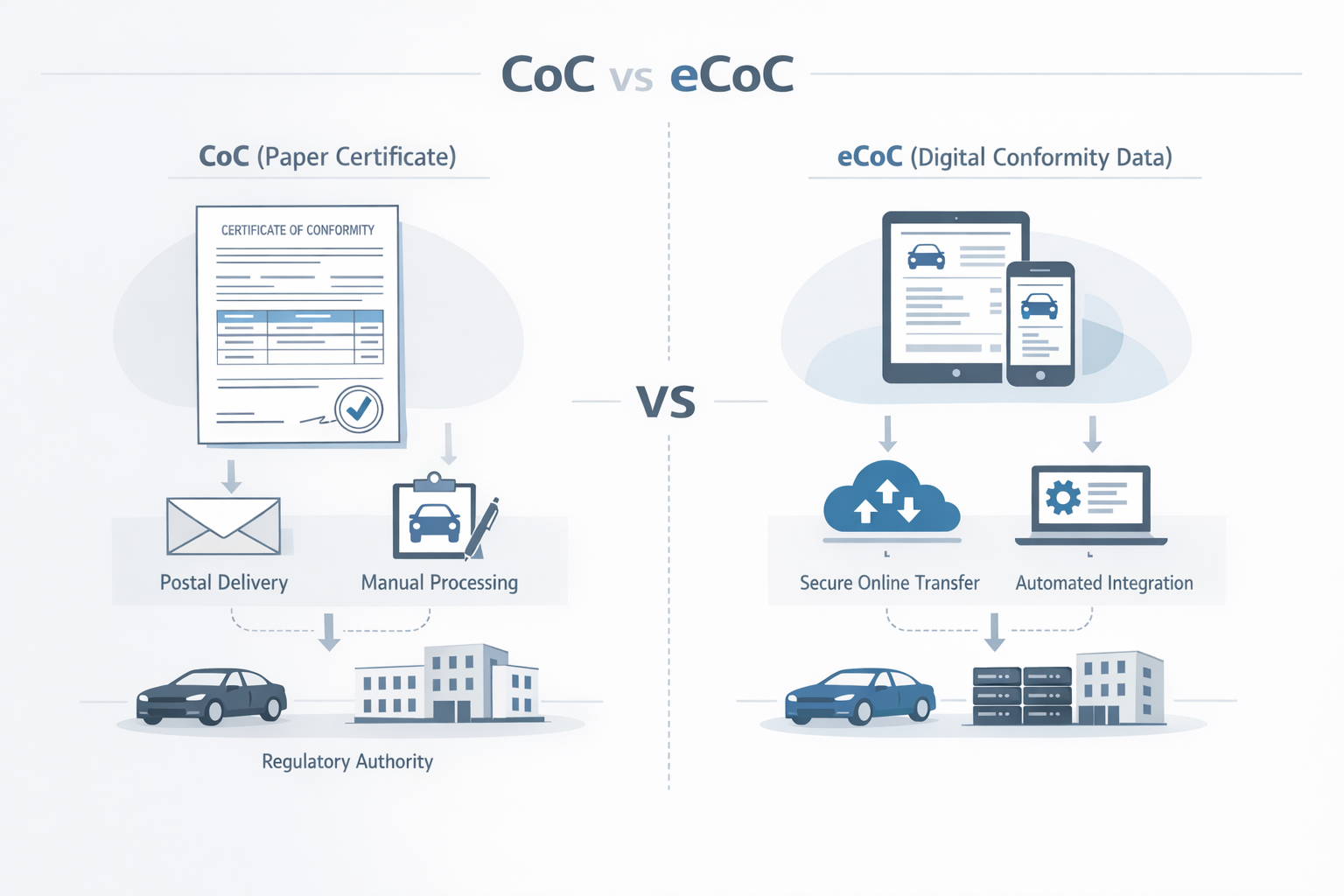
eCoC vs CoC matters because the same regulatory record must stay consistent across type approval, eCoC generation, IVI structures and registration-facing workflows.
eCoC vs CoC: Understanding the Difference in Vehicle Compliance Documentation
Vehicle conformity documentation is a fundamental part of the European automotive regulatory system. Manufacturers must demonstrate that vehicles correspond to approved technical specifications before those vehicles can be registered and operated within the European Union.
Two terms are frequently mentioned in this context: the traditional Certificate of Conformity (CoC) and the electronic Certificate of Conformity (eCoC). Although they represent similar regulatory information, the way the information is represented and exchanged differs significantly.
The Traditional Certificate of Conformity
The Certificate of Conformity is a document issued by a vehicle manufacturer confirming that a vehicle has been produced in accordance with an approved vehicle type. This document typically contains technical information describing the vehicle and its regulatory approval references.
Historically, the Certificate of Conformity was issued as a paper document accompanying the vehicle during registration procedures.
Limitations of Paper-Based Documentation
While paper documentation has been widely used for decades, it introduces limitations in environments where regulatory systems increasingly rely on digital data processing.
Paper documents require manual verification, storage, and interpretation. As regulatory datasets become more complex, relying solely on documentation can introduce administrative challenges.
The Emergence of eCoC
The electronic Certificate of Conformity represents the same regulatory information in structured digital form. Instead of describing vehicle characteristics through static documents, the information is represented using standardized data structures that can be interpreted by information systems.
This shift supports more efficient regulatory processes and helps ensure consistent interpretation of vehicle conformity information.
How eCoC Improves Data Consistency
Structured electronic data allows regulatory systems to process vehicle information automatically. This reduces the risk of inconsistencies that can arise when information must be interpreted manually from documentation.
Electronic conformity data also enables authorities to exchange vehicle information more efficiently when vehicles move across jurisdictions.
Role in Modern Compliance Systems
As regulatory frameworks continue to adopt digital data exchange, electronic conformity data is becoming increasingly important. Structured datasets help regulatory systems verify vehicle compliance more reliably.
However, managing this data correctly requires careful coordination between technical documentation, regulatory requirements, and structured data systems.
Frequently Asked Questions
What is the difference between CoC and eCoC?
CoC traditionally refers to the paper Certificate of Conformity, while eCoC represents the same information in structured digital form.
Do both contain the same information?
Both represent vehicle conformity information, but the format and method of exchange differ.
Why are electronic conformity certificates used?
Electronic formats support automated regulatory systems and improve consistency when exchanging vehicle data between authorities.
SEO Support Layer
Why eCoC vs CoC has become a strategic topic
eCoC vs CoC is no longer only a technical label. It now sits at the center of vehicle compliance operations because eCoC issuance, IVI data structures, type approval discipline and registration-facing regulatory workflows all depend on the same trusted information model. For manufacturers, homologation teams and compliance specialists, the real challenge is not producing one isolated file. It is keeping the underlying regulatory record aligned, reviewable and reusable across approval, verification and downstream authority processes. This page extends the article with that broader operating context so the keyword is understood as part of a full compliance system, not as a standalone definition.
How eCoC vs CoC connects to eCoC operations
eCoC vs CoC matters because electronic conformity processes only work when the underlying regulatory record is stable. If teams treat eCoC as a final deliverable instead of a governed operating flow, approval references, structured data and validation logic drift apart. In practice, that creates avoidable rework, inconsistent authority submissions and a weaker audit trail. The stronger approach is to connect eCoC vs CoC to the full operating model: source data, approval evidence, validation checkpoints, release controls and downstream registration readiness.
Type approval, IVI and verification in the same chain
A useful way to evaluate eCoC vs CoC is to place it inside the full compliance chain. Vehicle type approval defines the approved technical configuration. IVI structures carry that configuration through systems in a machine-readable form. Verification controls then confirm that the same data remains consistent when it is used in conformity, registration and regulatory workflows. Looking at eCoC vs CoC in isolation misses the fact that these layers depend on each other. The topic becomes operationally relevant only when approval, data structure and verification are managed as one continuous flow.
Why governance and system coordination are part of the keyword
Most problems around eCoC vs CoC are not caused by one missing parameter. They come from fragmented ownership across engineering records, manufacturing systems, approval files and registration-facing datasets. That is why governance, synchronization and system coordination are not abstract process ideas. They are the mechanisms that keep the same regulatory truth intact across teams and systems. When those controls are weak, compliance reviews become slower, outputs become harder to trust and the distance between approval data and market-facing operations grows.
What teams should prepare next
For most organizations, the practical next step around eCoC vs CoC is to map which systems generate the source data, which teams approve changes, which validation checks are required and which downstream process consumes the final record. Once that is visible, the topic stops being a narrow technical explanation and becomes part of a repeatable vehicle compliance workflow. That transition is critical when eCoC outputs, type approval references, IVI data handling and registration preparation all depend on the same controlled dataset.
Need help with vehicle compliance or eCoC processes?
Contact our team if you need help evaluating this topic at the level of product, process and rollout planning.
Frequently Asked Questions
Additional questions that connect the primary keyword in this article to eCoC, vehicle compliance and regulatory data operations.
Frequently Asked Questions
Reliable eCoC outputs depend on the technical and governance controls behind eCoC vs CoC, not just on the final XML or document layer.
Manufacturers, homologation specialists, regulatory consultants, body builders and verification teams all depend on the operating context behind eCoC vs CoC.
The main risk is data drift between systems, where approval records, structured datasets and downstream processes no longer represent the same vehicle configuration.
The main eCoC article, the vehicle compliance authority page, the IVI guide and the vehicle type approval guide should be read together as one topic cluster.
Related Guides
Curated internal guides that extend the same regulatory and operational topic cluster.
Technical Guides
How Vehicle Conformity Data Is Verified in European Compliance Systems
Learn how vehicle conformity data is verified within European compliance systems and why accurate regulatory datasets are essential.
Published: 7 March 2026
Read moreTechnical Guides
Why Vehicle Data Consistency Matters in Automotive Compliance
Learn why consistent vehicle regulatory data is critical for automotive compliance and how inconsistencies can affect regulatory verification processes.
Published: 7 March 2026
Read moreTechnical Guides
Why Automotive Compliance Data Requires Continuous Validation
Automotive compliance data must be continuously validated to maintain regulatory integrity. Learn why validation processes are critical for vehicle compliance systems.
Published: 7 March 2026
Read moreRegulations
Why Vehicle Approval Documentation Must Remain Consistent
Vehicle approval documentation must remain consistent across regulatory systems. Learn why documentation alignment is essential for automotive compliance.
Published: 7 March 2026
Read more