
EUCARIS National Access Points matters because the same regulatory record must stay consistent across type approval, eCoC generation, IVI structures and registration-facing workflows.
EUCARIS and National Access Points: How Electronic CoC Data Reaches Authorities
Electronic CoC workflows are often described from the manufacturer side: collect the data, validate the output, prepare the XML and release the message. But another part of the picture matters just as much: how that structured information reaches authority-facing systems. This is where EUCARIS and National Access Point concepts become important in the wider compliance conversation.
Manufacturers may not operate these exchange layers directly, yet they still need to understand them. The authority side of the process places pressure on upstream data quality. If the submitted record cannot move reliably through national and cross-border exchange structures, the operational cost of inconsistency increases quickly.
Why the Exchange Layer Matters
Vehicle conformity and registration processes do not end at the moment an output is generated. Regulatory data may need to be reviewed, routed or referenced by systems beyond the manufacturer environment. That means the exchange layer is not a secondary infrastructure issue. It is part of the real-world destination of the structured vehicle record.
When teams understand the exchange layer, they make better upstream decisions. They become more careful about approval traceability, field consistency and repeatable validation because they know the record must survive beyond internal workflows.
What EUCARIS Contributes
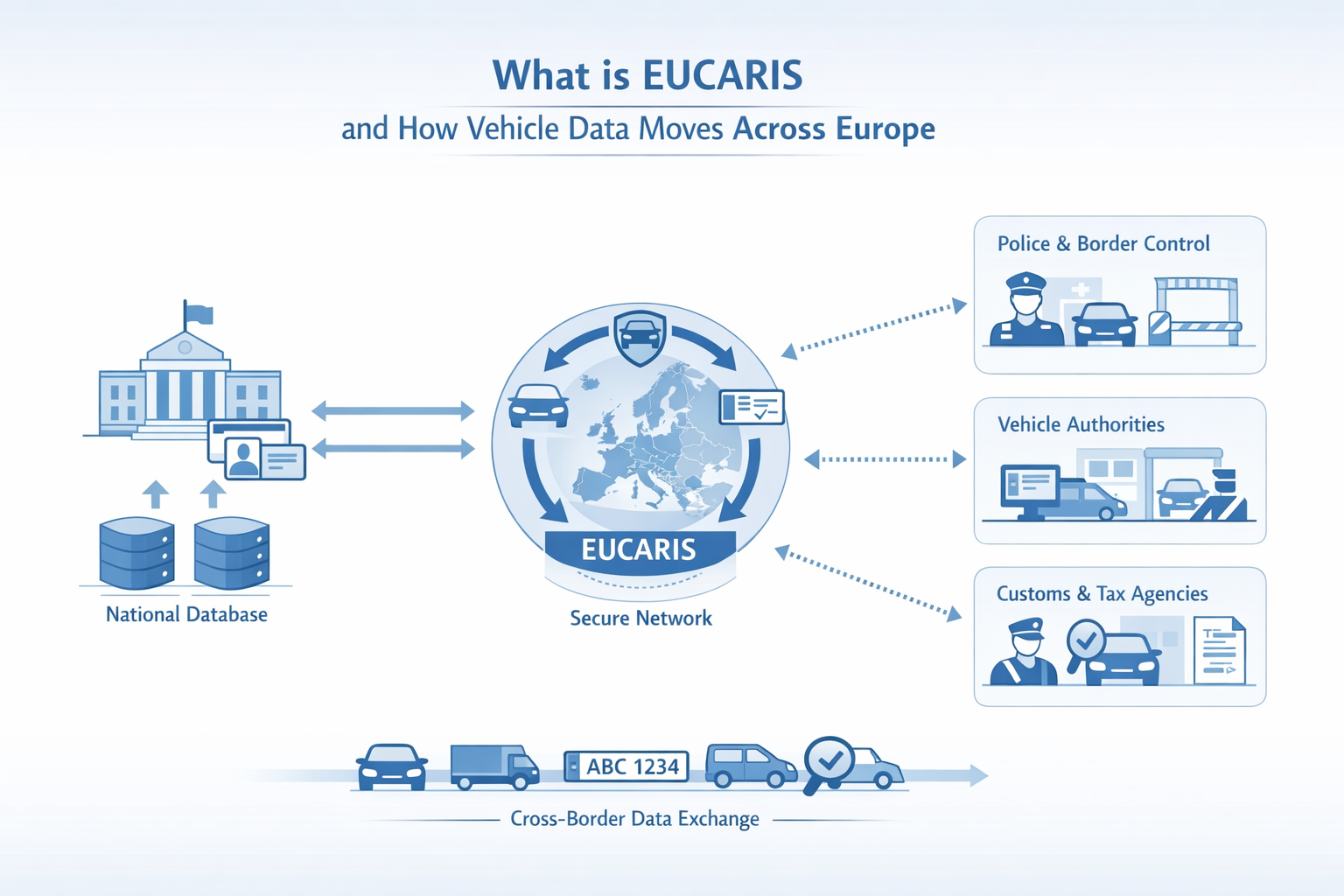
EUCARIS supports cross-border vehicle and driving licence information exchange between national systems. In the vehicle compliance context, it helps explain how trusted vehicle information can move across authorities without forcing every system into one central database. That model is important because it reflects the reality of European regulatory cooperation: multiple authorities, multiple systems and one need for consistent records.
EUCARIS therefore acts as an exchange concept within the wider compliance architecture. It is not the same thing as eCoC generation, but it helps show why electronic conformity data must be structured in a way that remains reliable after release.
Where National Access Points Fit
National Access Points matter because each authority environment still needs a controlled way to receive and work with structured data. They are part of the operational path between a manufacturer-ready output and an authority-ready process. Even when the exact national implementation differs, the implication for manufacturers is similar: outputs should be prepared as controlled regulatory records rather than as local technical artifacts.
That changes how readiness is evaluated. It is no longer enough to ask whether an XML file was created. Teams also need to ask whether the message represents the right approval references, whether values remain synchronized across systems and whether the release package is robust enough for authority-side use.
How This Connects to eCoC and IVI
The exchange layer depends on the same upstream record quality that supports eCoC and IVI. If vehicle identity, technical parameters and approval references are already well governed, authority-facing exchange becomes easier. If they are weak, the downstream exchange model simply exposes those weaknesses more clearly.
That is why EUCARIS and National Access Point topics should not be separated from IVI and eCoC. They belong to the same compliance chain. One defines how data is structured, another packages the conformity output and another explains how trusted information reaches the receiving side.
Practical Implications for Manufacturers
Manufacturers should use the exchange layer as a design constraint. They should ask whether the output can be defended outside the originating team, whether the source values remain reviewable and whether the same record can be understood consistently by downstream authorities. That perspective usually leads to stronger validation rules and better ownership clarity long before submission.
It also helps organizations avoid a common mistake: treating the authority side as someone else’s problem. In reality, authority expectations shape upstream readiness. The more connected the ecosystem becomes, the less room there is for disconnected local data practices.
Why This Topic Matters for SEO and Topic Authority
Search intent around EUCARIS, National Access Points and electronic CoC data exchange is more specialized than broad eCoC or vehicle compliance terms. That makes this page a supporting cluster asset rather than a competing pillar. Its role is to strengthen the authority structure by explaining a key downstream layer that many broader pages only mention briefly.
Frequently Asked Questions
Do manufacturers need to understand EUCARIS even if they do not run it?
Yes. It helps them understand why trusted structured data is necessary beyond internal release workflows.
What do National Access Points imply for eCoC preparation?
They reinforce the need for submission-ready, well-governed and reviewable vehicle records before authority exchange begins.
How does this topic connect to IVI?
IVI supports the machine-readable upstream record that helps make downstream electronic exchange more reliable.
SEO Support Layer
Why EUCARIS National Access Points has become a strategic topic
EUCARIS National Access Points is no longer only a technical label. It now sits at the center of vehicle compliance operations because eCoC issuance, IVI data structures, type approval discipline and registration-facing regulatory workflows all depend on the same trusted information model. For manufacturers, homologation teams and compliance specialists, the real challenge is not producing one isolated file. It is keeping the underlying regulatory record aligned, reviewable and reusable across approval, verification and downstream authority processes. This page extends the article with that broader operating context so the keyword is understood as part of a full compliance system, not as a standalone definition.
How EUCARIS National Access Points connects to eCoC operations
EUCARIS National Access Points matters because electronic conformity processes only work when the underlying regulatory record is stable. If teams treat eCoC as a final deliverable instead of a governed operating flow, approval references, structured data and validation logic drift apart. In practice, that creates avoidable rework, inconsistent authority submissions and a weaker audit trail. The stronger approach is to connect EUCARIS National Access Points to the full operating model: source data, approval evidence, validation checkpoints, release controls and downstream registration readiness.
Type approval, IVI and verification in the same chain
A useful way to evaluate EUCARIS National Access Points is to place it inside the full compliance chain. Vehicle type approval defines the approved technical configuration. IVI structures carry that configuration through systems in a machine-readable form. Verification controls then confirm that the same data remains consistent when it is used in conformity, registration and regulatory workflows. Looking at EUCARIS National Access Points in isolation misses the fact that these layers depend on each other. The topic becomes operationally relevant only when approval, data structure and verification are managed as one continuous flow.
Why governance and system coordination are part of the keyword
Most problems around EUCARIS National Access Points are not caused by one missing parameter. They come from fragmented ownership across engineering records, manufacturing systems, approval files and registration-facing datasets. That is why governance, synchronization and system coordination are not abstract process ideas. They are the mechanisms that keep the same regulatory truth intact across teams and systems. When those controls are weak, compliance reviews become slower, outputs become harder to trust and the distance between approval data and market-facing operations grows.
What teams should prepare next
For most organizations, the practical next step around EUCARIS National Access Points is to map which systems generate the source data, which teams approve changes, which validation checks are required and which downstream process consumes the final record. Once that is visible, the topic stops being a narrow technical explanation and becomes part of a repeatable vehicle compliance workflow. That transition is critical when eCoC outputs, type approval references, IVI data handling and registration preparation all depend on the same controlled dataset.
Need help with vehicle compliance or eCoC processes?
Contact our team if you need help evaluating this topic at the level of product, process and rollout planning.
Frequently Asked Questions
Additional questions that connect the primary keyword in this article to eCoC, vehicle compliance and regulatory data operations.
Frequently Asked Questions
Reliable eCoC outputs depend on the technical and governance controls behind EUCARIS National Access Points, not just on the final XML or document layer.
Manufacturers, homologation specialists, regulatory consultants, body builders and verification teams all depend on the operating context behind EUCARIS National Access Points.
The main risk is data drift between systems, where approval records, structured datasets and downstream processes no longer represent the same vehicle configuration.
The main eCoC article, the vehicle compliance authority page, the IVI guide and the vehicle type approval guide should be read together as one topic cluster.
Related Guides
Curated internal guides that extend the same regulatory and operational topic cluster.
Technical Guides
Why Vehicle Compliance Data Must Remain Aligned Across Systems
Vehicle compliance data must remain aligned across multiple regulatory systems. Learn why data alignment is essential for automotive compliance.
Published: 7 March 2026
Read moreTechnical Guides
Why Regulatory Vehicle Data Must Be Managed Carefully
Vehicle regulatory data plays a critical role in compliance systems. Learn why managing this data carefully is essential for reliable regulatory verification.
Published: 7 March 2026
Read moreVehicle Type Approval
How European Vehicle Approval Works
Learn how the European vehicle type approval system works and how vehicles are verified for compliance before entering the EU market.
Published: 7 March 2026
Read moreTechnical Guides
Why Automotive Compliance Data Requires Continuous Validation
Automotive compliance data must be continuously validated to maintain regulatory integrity. Learn why validation processes are critical for vehicle compliance systems.
Published: 7 March 2026
Read more