
EUCARIS matters because the same regulatory record must stay consistent across type approval, eCoC generation, IVI structures and registration-facing workflows.
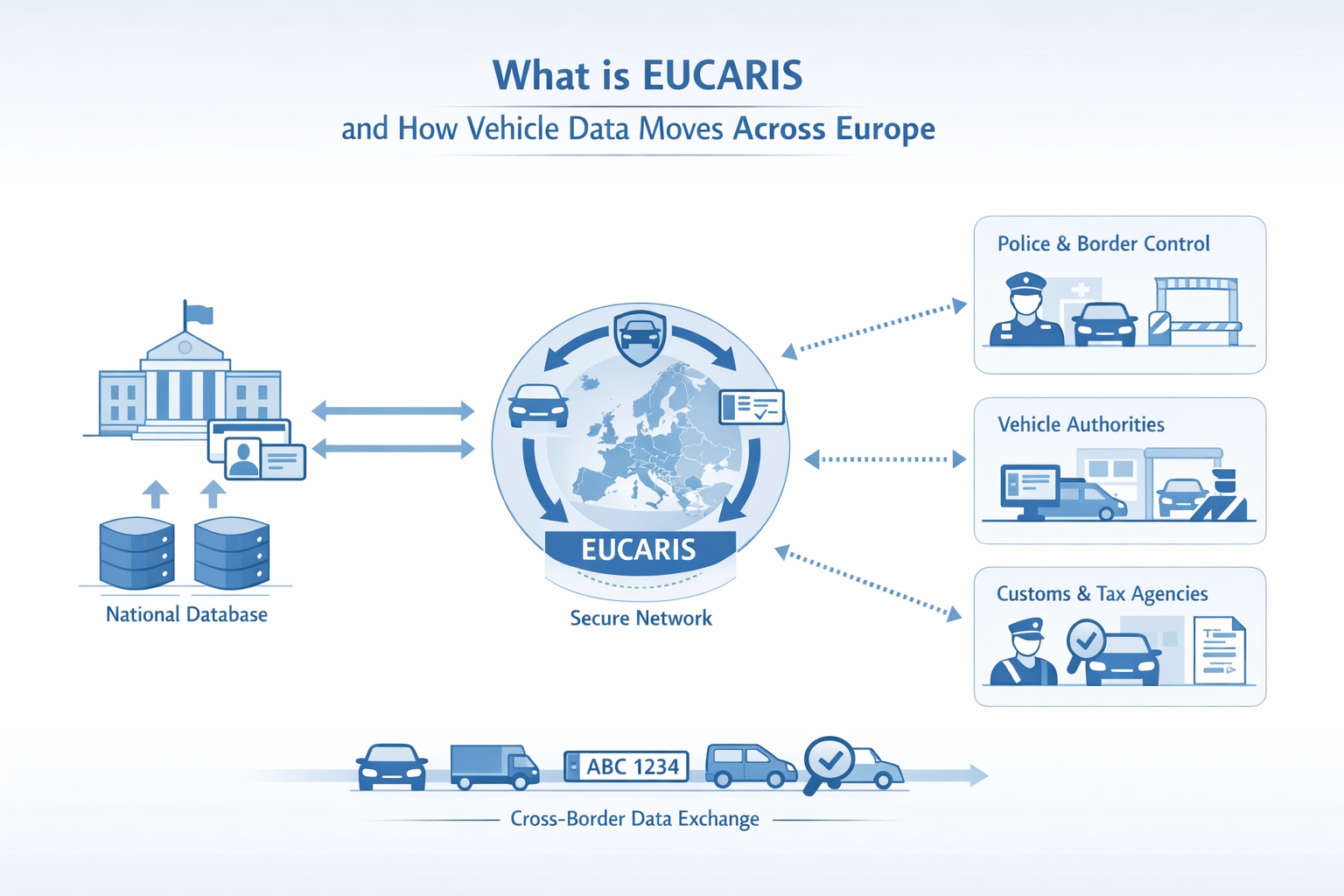
What is EUCARIS and How Vehicle Data Moves Across Europe
Vehicle registration and regulatory verification often require information to move between different countries. In Europe, authorities cooperate through several systems that allow vehicle information to be exchanged in a secure and structured way. One of the key systems supporting this cooperation is EUCARIS.
Understanding EUCARIS
EUCARIS stands for European Car and Driving Licence Information System. It is a platform that allows national authorities to exchange information related to vehicles and driving licences.
The system enables authorities in different countries to communicate with each other when verifying regulatory information.
Why Vehicle Data Exchange Is Necessary
Vehicles frequently move between countries for registration, resale, or operational purposes. When this happens, authorities may need to verify the regulatory status of a vehicle that was originally approved or registered in another country.
Without reliable data exchange mechanisms, verifying such information would be significantly more complicated.
How EUCARIS Supports Authorities
EUCARIS allows national vehicle registries to communicate directly with each other. Instead of storing all vehicle data in a single central database, the system connects national systems while allowing each country to maintain its own registry.
This model allows authorities to verify vehicle information when needed.
Types of Data Shared Through EUCARIS
The system can support the exchange of several types of regulatory information related to vehicles and drivers.
- Vehicle registration data
- Vehicle identification information
- Driving licence data
- Administrative vehicle records
This information helps authorities verify vehicle status during regulatory processes.
Benefits of Cross-Border Data Cooperation
Systems like EUCARIS help improve cooperation between regulatory authorities across Europe. Reliable information exchange allows authorities to verify vehicle records more efficiently.
This contributes to more consistent regulatory enforcement and improved administrative processes.
Challenges of Cross-System Data Exchange
Although data exchange systems improve cooperation, managing regulatory data across multiple jurisdictions still requires careful coordination. Vehicle information must remain accurate and consistent across different regulatory systems.
Maintaining reliable regulatory datasets therefore remains an important task for organizations involved in automotive compliance.
Frequently Asked Questions
What does EUCARIS stand for?
EUCARIS stands for European Car and Driving Licence Information System.
Who uses EUCARIS?
National regulatory authorities responsible for vehicle registration and licensing may use EUCARIS to exchange information.
Why is cross-border vehicle data exchange important?
It allows authorities to verify vehicle information when vehicles move between different countries.
SEO Support Layer
EUCARIS explains the cross-border layer of the compliance ecosystem
EUCARIS is not the highest-volume head term in the cluster, but it is one of the strongest authority signals because it points directly to cross-border regulatory cooperation. Readers who land here need more than a system acronym. They need to understand why national registries, verification workflows and trusted regulatory datasets must connect across borders. This page therefore works best when it turns EUCARIS into a clear explanation of the exchange layer within the wider eCoC and vehicle compliance model.
Why EUCARIS matters to vehicle compliance
Vehicle compliance does not stop at one authority or one national database. Once a vehicle moves across jurisdictions, trusted access to regulatory records becomes essential. EUCARIS matters because it represents the exchange model that allows national systems to cooperate without collapsing into one central registry.
How EUCARIS connects to eCoC, IVI and verification
Cross-border exchange only works when the underlying vehicle record is already well governed. That is why EUCARIS should not be read as a standalone network topic. It depends on the same upstream quality controls that support eCoC outputs, IVI data structures and approval-linked verification. The exchange layer is only as reliable as the record it carries.
What manufacturers and compliance teams should take from EUCARIS
Manufacturers may not operate EUCARIS directly, but they still benefit from understanding it because it clarifies why clean regulatory data, strong reference integrity and synchronized outputs matter beyond the first approval event. The more vehicle data moves, the more expensive inconsistency becomes.
Why this page should feed the authority cluster
A strong EUCARIS page supports authority, not isolation. It should route readers into the eCoC pillar, the main vehicle compliance page, IVI data guidance and synchronization topics so the exchange layer is understood as one piece of a larger controlled system.
Recommended reading path
Core guides that connect this pillar page to the rest of the topic cluster.
Main eCoC article
Start from the core explanation of the Electronic Certificate of Conformity and its role in Europe.
Read moreVehicle compliance authority page
See how eCoC, IVI, type approval and regulatory data governance connect in one authority layer.
Read moreVehicle type approval guide
Review the approved vehicle configuration that anchors downstream conformity and verification flows.
Read moreIVI guide
Understand how Initial Vehicle Information carries trusted technical data across systems.
Read moreKnowledge hub
Open the full topic cluster and continue through every pillar and supporting guide.
Read moreNeed help with vehicle compliance or eCoC processes?
Contact our team if you need help evaluating this topic at the level of product, process and rollout planning.
Frequently Asked Questions
Additional questions that connect the primary keyword in this article to eCoC, vehicle compliance and regulatory data operations.
Frequently Asked Questions
Reliable eCoC outputs depend on the technical and governance controls behind EUCARIS, not just on the final XML or document layer.
Manufacturers, homologation specialists, regulatory consultants, body builders and verification teams all depend on the operating context behind EUCARIS.
The main risk is data drift between systems, where approval records, structured datasets and downstream processes no longer represent the same vehicle configuration.
The main eCoC article, the vehicle compliance authority page, the IVI guide and the vehicle type approval guide should be read together as one topic cluster.
Related Guides
Curated internal guides that extend the same regulatory and operational topic cluster.
Technical Guides
Why Vehicle Compliance Data Must Remain Aligned Across Systems
Vehicle compliance data must remain aligned across multiple regulatory systems. Learn why data alignment is essential for automotive compliance.
Published: 7 March 2026
Read moreTechnical Guides
How Regulatory Vehicle Data Must Stay Synchronized Across Systems
Discover why regulatory vehicle data must remain synchronized across automotive systems and how synchronization supports reliable compliance verification.
Published: 7 March 2026
Read moreTechnical Guides
How Vehicle Compliance Systems Coordinate Regulatory Data
Learn how vehicle compliance systems coordinate regulatory data across approval, verification, and registration processes.
Published: 7 March 2026
Read moreeCoC
Understanding Electronic Certificates of Conformity in European Vehicle Compliance
Learn how electronic Certificates of Conformity (eCoC) support vehicle approval and compliance processes across Europe.
Published: 7 March 2026
Read more