
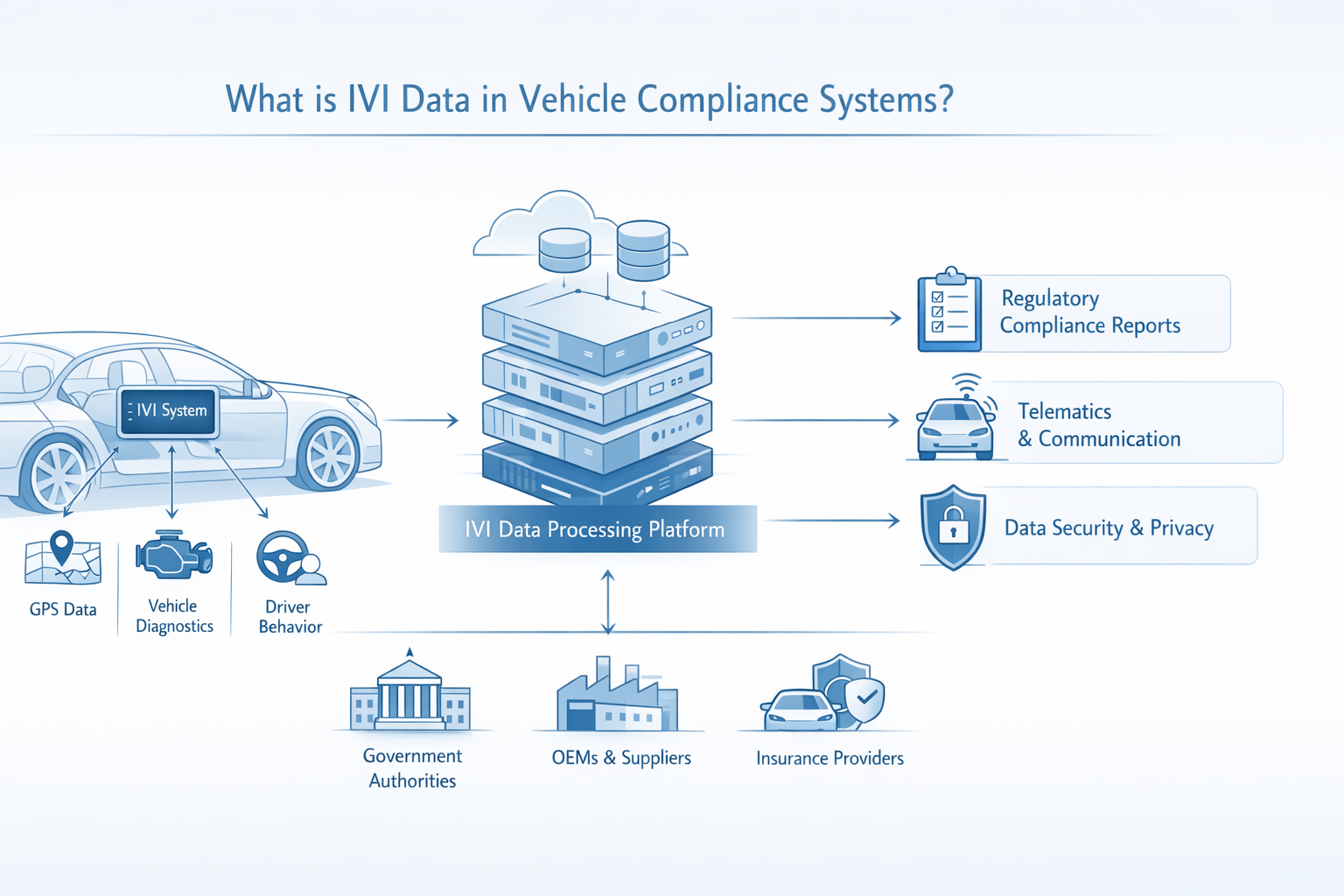
IVI matters because the same regulatory record must stay consistent across type approval, eCoC generation, IVI structures and registration-facing workflows.
What is IVI Data in Vehicle Compliance Systems?
Vehicle compliance systems in Europe increasingly rely on structured digital data to represent regulatory information. One of the key data structures used in these systems is IVI, which stands for Initial Vehicle Information. IVI data provides a structured description of vehicle characteristics used during regulatory processes.
The Purpose of IVI Data
IVI data is designed to represent essential vehicle information in a structured format that regulatory systems can process consistently. This information may include vehicle identification details, manufacturer information, technical specifications, and references to regulatory approvals.
By organizing this information in structured datasets, regulatory systems can interpret vehicle characteristics more reliably.
Why Structured Vehicle Data Matters
Vehicle compliance processes often involve multiple regulatory systems and authorities. Each of these systems may rely on vehicle data to verify that a vehicle corresponds to the approved specifications.
Structured datasets such as IVI help ensure that this information remains consistent across different regulatory environments.
How IVI Supports Compliance Processes
IVI datasets describe the technical identity of a vehicle within compliance systems. Authorities may rely on this information when verifying vehicle approval data or evaluating regulatory documentation.
Because IVI data is structured, it can be interpreted automatically by information systems used in regulatory workflows.
IVI and Digital Vehicle Compliance
As regulatory frameworks continue to adopt digital data exchange models, structured datasets such as IVI are becoming increasingly important. These datasets allow vehicle information to move between systems while preserving the integrity of regulatory data.
This approach supports more efficient compliance verification and regulatory coordination.
Challenges in Managing IVI Data
While structured datasets improve consistency, managing IVI data can still be complex. Vehicle information may originate from engineering documentation, approval records, and production data. Ensuring that all sources remain consistent requires careful data management.
Maintaining reliable regulatory datasets often requires specialized expertise and structured compliance workflows.
Frequently Asked Questions
What does IVI stand for?
IVI stands for Initial Vehicle Information and represents structured regulatory data describing vehicle characteristics.
Why is IVI data used in vehicle compliance systems?
IVI helps regulatory systems interpret vehicle information consistently and supports structured data exchange between authorities.
Who uses IVI data?
Manufacturers, regulatory authorities, and vehicle registration systems may rely on IVI datasets during compliance verification processes.
SEO Support Layer
IVI data is the machine-readable spine of vehicle compliance
IVI data has weaker broad awareness than eCoC or vehicle type approval, but it is strategically important because it turns approval truth into structured regulatory records. Searchers landing here usually need the operational bridge between legal approval concepts and system-ready vehicle data. That makes this page critical for explaining how Initial Vehicle Information supports eCoC generation, synchronization and validation across multiple compliance surfaces.
Why IVI matters beyond technical formatting
It is easy to describe IVI as a structured data model and stop there. The stronger explanation is that IVI gives manufacturers and authorities a repeatable way to carry approved vehicle identity and technical characteristics without relying on manual document interpretation alone. That turns IVI into an execution layer for compliance, not just a format choice.
How IVI supports eCoC readiness
Reliable eCoC generation depends on clean upstream data. IVI structures help organize that upstream layer so vehicle identity, approval references and technical parameters can move through validation and release steps with fewer interpretation gaps. If IVI is weak, eCoC becomes harder to trust even when the final output appears complete.
Why IVI, synchronization and governance belong together
IVI only delivers value when the same dataset remains aligned across engineering, approval, release and registration-facing use. That means synchronization, governance and data ownership are not secondary process concerns. They are part of the IVI topic itself. Teams that separate IVI from governance usually create more manual correction work later.
What readers should connect IVI to next
This page should naturally lead into the eCoC pillar, the vehicle compliance authority page, vehicle type approval and the technical guidance around validation and data consistency. That linked reading path is how IVI becomes understandable as a business-critical compliance layer instead of a niche technical acronym.
Recommended reading path
Core guides that connect this pillar page to the rest of the topic cluster.
Main eCoC article
Start from the core explanation of the Electronic Certificate of Conformity and its role in Europe.
Read moreVehicle compliance authority page
See how eCoC, IVI, type approval and regulatory data governance connect in one authority layer.
Read moreVehicle type approval guide
Review the approved vehicle configuration that anchors downstream conformity and verification flows.
Read moreEUCARIS guide
Read how cross-border vehicle data exchange supports registration and verification workflows.
Read moreKnowledge hub
Open the full topic cluster and continue through every pillar and supporting guide.
Read moreNeed help with vehicle compliance or eCoC processes?
Contact our team if you need help evaluating this topic at the level of product, process and rollout planning.
Frequently Asked Questions
Additional questions that connect the primary keyword in this article to eCoC, vehicle compliance and regulatory data operations.
Frequently Asked Questions
Reliable eCoC outputs depend on the technical and governance controls behind IVI, not just on the final XML or document layer.
Manufacturers, homologation specialists, regulatory consultants, body builders and verification teams all depend on the operating context behind IVI.
The main risk is data drift between systems, where approval records, structured datasets and downstream processes no longer represent the same vehicle configuration.
The main eCoC article, the vehicle compliance authority page, the IVI guide and the vehicle type approval guide should be read together as one topic cluster.
Related Guides
Curated internal guides that extend the same regulatory and operational topic cluster.
Technical Guides
How Vehicle Compliance Systems Coordinate Regulatory Data
Learn how vehicle compliance systems coordinate regulatory data across approval, verification, and registration processes.
Published: 7 March 2026
Read moreTechnical Guides
Why Automotive Regulatory Data Requires Strong Data Governance
Learn why automotive regulatory data requires strong governance and how proper data management supports reliable compliance processes.
Published: 7 March 2026
Read moreTechnical Guides
Why Vehicle Compliance Data Must Remain Aligned Across Systems
Vehicle compliance data must remain aligned across multiple regulatory systems. Learn why data alignment is essential for automotive compliance.
Published: 7 March 2026
Read moreTechnical Guides
Why Automotive Compliance Data Requires Continuous Validation
Automotive compliance data must be continuously validated to maintain regulatory integrity. Learn why validation processes are critical for vehicle compliance systems.
Published: 7 March 2026
Read more