
vehicle type approval matters because the same regulatory record must stay consistent across type approval, eCoC generation, IVI structures and registration-facing workflows.
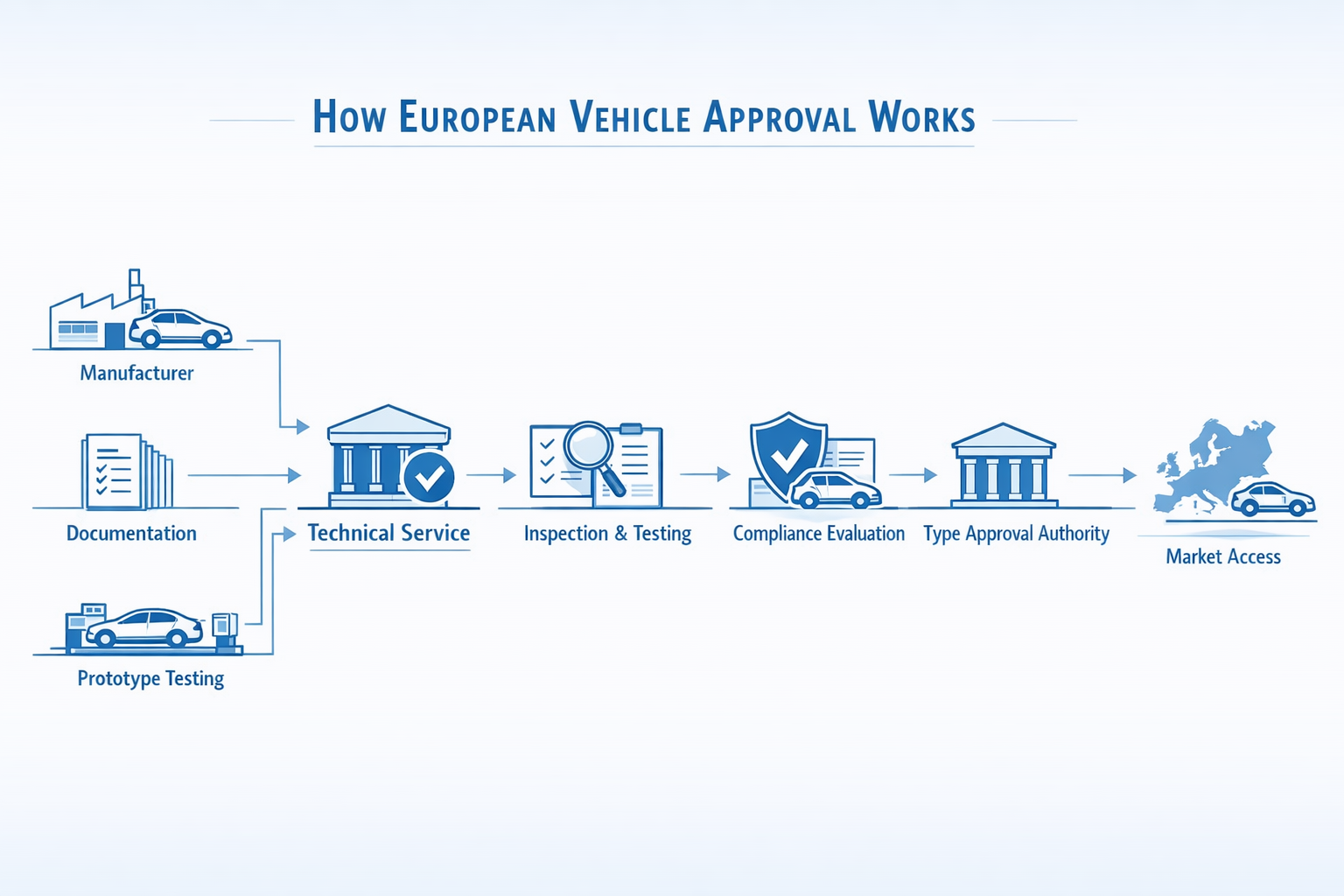
How European Vehicle Approval Works
Before a vehicle can be placed on the European market, it must comply with a structured regulatory framework known as the vehicle type approval system. This system ensures that vehicles meet safety, environmental, and technical requirements established by European legislation.
The Purpose of Vehicle Type Approval
Vehicle type approval exists to ensure that vehicles sold in the European Union meet harmonized standards. Instead of verifying each individual vehicle from scratch, regulators evaluate a representative vehicle type and confirm that it complies with regulatory requirements.
Once a vehicle type is approved, vehicles produced under that type may be placed on the market provided they remain consistent with the approved specifications.
Regulatory Authorities and Approval Bodies
The approval process involves designated approval authorities that evaluate whether a vehicle design meets regulatory requirements. These authorities review documentation, technical specifications, and test results associated with the vehicle.
The goal of this process is to confirm that the vehicle type complies with the relevant regulatory framework.
Stages of the Approval Process
The vehicle approval process typically includes several stages of verification. Manufacturers must provide technical documentation describing the vehicle and demonstrate compliance with applicable regulations.
Authorities review this information and determine whether the vehicle type satisfies regulatory requirements.
Type Approval and Vehicle Production
Once a vehicle type has been approved, manufacturers may produce vehicles under that approval. However, production vehicles must remain consistent with the approved technical specifications.
This consistency ensures that vehicles placed on the market continue to comply with the regulatory framework.
The Importance of Accurate Compliance Data
Vehicle approval processes rely on accurate technical data describing the vehicle. This data forms the basis for regulatory verification and is often referenced throughout the lifecycle of the vehicle.
Maintaining reliable regulatory data therefore plays an important role in compliance processes.
Modern Trends in Vehicle Approval
Automotive regulatory systems are increasingly moving toward digital data exchange and structured regulatory information. These systems allow authorities to process vehicle compliance information more efficiently.
As regulatory processes continue to evolve, managing structured vehicle data becomes an increasingly important aspect of automotive compliance.
Frequently Asked Questions
What is vehicle type approval?
Vehicle type approval is the process used to verify that a vehicle design complies with regulatory requirements before vehicles are placed on the market.
Who grants vehicle approval?
Designated approval authorities are responsible for evaluating and granting vehicle type approvals.
Why is type approval necessary?
It ensures that vehicles meet safety, environmental, and technical standards defined by regulatory frameworks.
SEO Support Layer
Vehicle type approval is the control point for the full compliance stack
Vehicle type approval is one of the hardest head terms in the cluster because it sits close to official and quasi-official search results. To compete, the page has to explain more than the legal concept. It needs to show why type approval matters operationally for manufacturers, body builders, homologation teams and eCoC rollout planning. The real value of this page is that it connects the approved vehicle configuration to downstream IVI structures, conformity outputs and registration-facing verification workflows.
Why type approval is more than a legal checkpoint
In practice, vehicle type approval is the source of truth that stabilizes every later compliance output. Once the approved configuration is set, that same record has to remain consistent across technical documentation, production interpretation, IVI structures and eCoC release logic. Treating type approval as a one-time approval event misses its role as the governing baseline for the full compliance lifecycle.
How manufacturers should connect approval data to downstream operations
Manufacturers get more value from type approval when they structure it as reusable operational data instead of isolated evidence files. Approval references, parameter definitions and controlled change decisions should feed downstream processes without manual reinterpretation. That is where type approval starts to influence eCoC reliability, validation quality and downstream authority readiness.
Why multistage and body-built programs raise the stakes
Type approval complexity increases when more than one manufacturer or conversion stage participates in the final vehicle outcome. In those programs, document integrity, role ownership and approval boundaries become especially important. Search intent around vehicle type approval often expands into these operational questions, so the pillar page needs to point readers toward those deeper scenarios.
What this keyword should lead readers toward next
A strong vehicle type approval page should route readers into eCoC generation, IVI data structure, EUCARIS-facing exchange and validation governance. The keyword wins when the page acts as the approval anchor of the cluster rather than as a narrow glossary entry.
Recommended reading path
Core guides that connect this pillar page to the rest of the topic cluster.
Main eCoC article
Start from the core explanation of the Electronic Certificate of Conformity and its role in Europe.
Read moreVehicle compliance authority page
See how eCoC, IVI, type approval and regulatory data governance connect in one authority layer.
Read moreIVI guide
Understand how Initial Vehicle Information carries trusted technical data across systems.
Read moreEUCARIS guide
Read how cross-border vehicle data exchange supports registration and verification workflows.
Read moreKnowledge hub
Open the full topic cluster and continue through every pillar and supporting guide.
Read moreNeed help with vehicle compliance or eCoC processes?
Contact our team if you need help evaluating this topic at the level of product, process and rollout planning.
Frequently Asked Questions
Additional questions that connect the primary keyword in this article to eCoC, vehicle compliance and regulatory data operations.
Frequently Asked Questions
Reliable eCoC outputs depend on the technical and governance controls behind vehicle type approval, not just on the final XML or document layer.
Manufacturers, homologation specialists, regulatory consultants, body builders and verification teams all depend on the operating context behind vehicle type approval.
The main risk is data drift between systems, where approval records, structured datasets and downstream processes no longer represent the same vehicle configuration.
The main eCoC article, the vehicle compliance authority page, the IVI guide and the vehicle type approval guide should be read together as one topic cluster.
Related Guides
Curated internal guides that extend the same regulatory and operational topic cluster.
Technical Guides
How Vehicle Approval Data Flows Through Automotive Regulatory Systems
Discover how vehicle approval data moves across automotive regulatory systems and why structured data flows are important for compliance processes.
Published: 7 March 2026
Read moreBody-Built Vehicles
Understanding Multistage Vehicle Approval in Europe
Learn how multistage vehicle approval works in Europe and how different manufacturers contribute to the compliance of specialized vehicles.
Published: 7 March 2026
Read moreTechnical Guides
Why Automotive Compliance Data Requires Continuous Validation
Automotive compliance data must be continuously validated to maintain regulatory integrity. Learn why validation processes are critical for vehicle compliance systems.
Published: 7 March 2026
Read moreeCoC
Understanding Electronic Certificates of Conformity in European Vehicle Compliance
Learn how electronic Certificates of Conformity (eCoC) support vehicle approval and compliance processes across Europe.
Published: 7 March 2026
Read more