Technical Guides

Common Challenges in Managing Vehicle Compliance Data

Managing vehicle compliance data can be complex. Learn about the common challenges organizations face when handling regulatory vehicle datasets.

Published4 April 2025
Read time6 min read
Words321
Common Challenges in Managing Vehicle Compliance Data

Common Challenges in Managing Vehicle Compliance Data

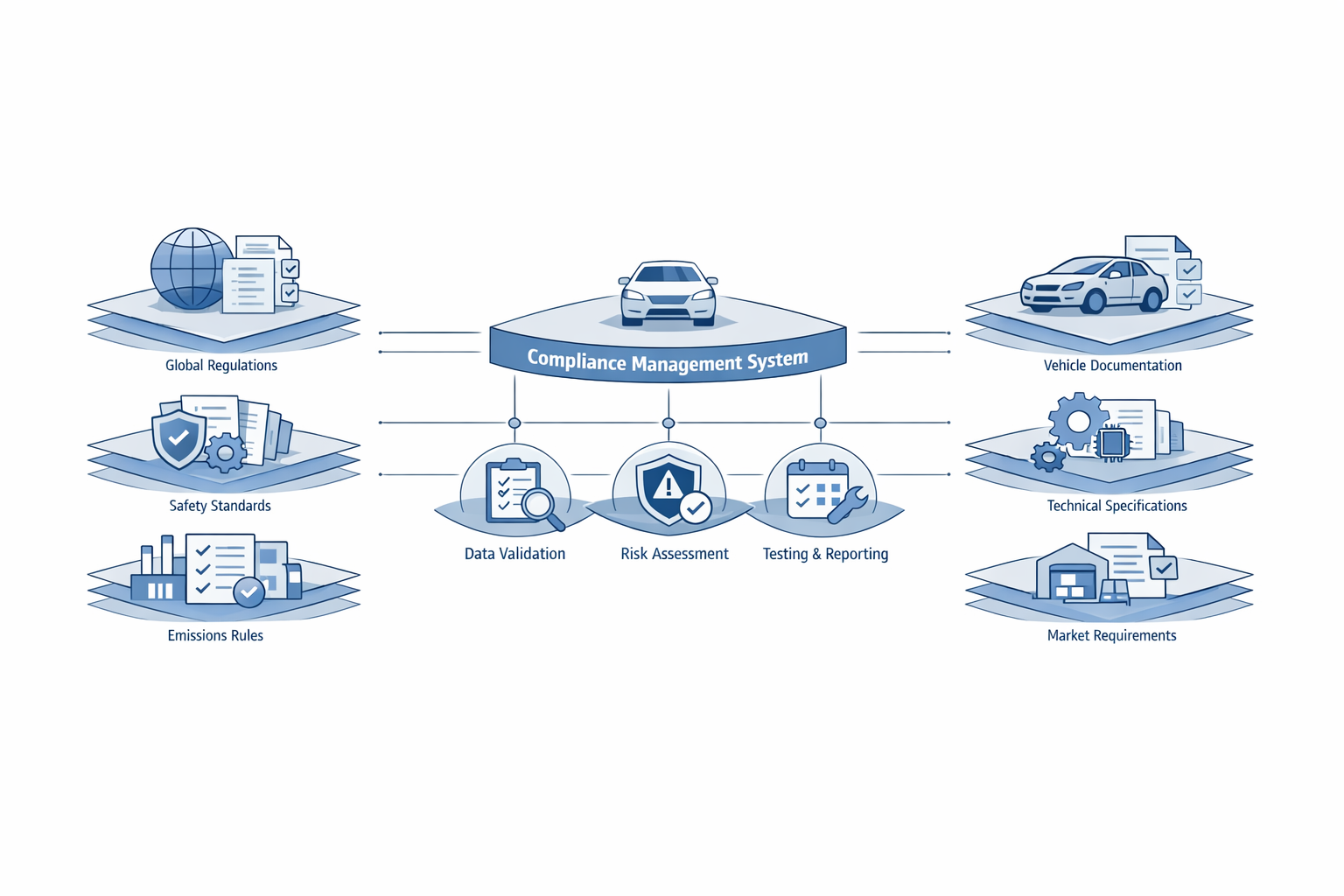
Automotive regulatory systems depend on large datasets describing the technical characteristics of vehicles. These datasets are used during approval, verification, and registration processes. Managing such information can be challenging due to the complexity of regulatory requirements.

Organizations responsible for vehicle compliance often need to manage multiple data sources while ensuring that regulatory datasets remain accurate and consistent.

Multiple Data Sources

Vehicle compliance information may originate from engineering documentation, manufacturing systems, regulatory approvals, and administrative records. Each of these sources may contain critical technical information describing the vehicle.

Ensuring that these sources remain aligned is essential for maintaining reliable regulatory datasets.

Complex Technical Parameters

Vehicle regulatory datasets may include numerous technical parameters. These parameters describe the vehicle's design, performance characteristics, and regulatory references.

Because these parameters are often interconnected, maintaining consistency across them can be difficult.

Regulatory Changes

Automotive regulations evolve over time as new safety standards, environmental requirements, and technological developments emerge. Regulatory changes can affect the structure and interpretation of compliance datasets.

Organizations must ensure that their regulatory information remains aligned with current requirements.

Coordination Between Systems

Compliance datasets may be used by multiple systems including approval authorities, vehicle registration systems, and regulatory oversight platforms. Coordinating data between these systems requires careful management.

Without reliable coordination, inconsistencies may appear in regulatory datasets.

The Importance of Data Governance

Effective data governance processes help organizations maintain reliable regulatory datasets. Governance procedures ensure that technical information remains accurate and consistent across compliance workflows.

These processes help support efficient regulatory verification and compliance management.

Frequently Asked Questions

Why is managing vehicle compliance data difficult?

Because regulatory datasets often contain many interconnected technical parameters originating from multiple sources.

What causes inconsistencies in compliance data?

Inconsistencies may occur when engineering data, approval documentation, and administrative records are not properly aligned.

How can organizations manage compliance datasets effectively?

Structured data governance and reliable compliance workflows help maintain consistent regulatory information.
Practical context

Why vehicle compliance data challenges matters in practice

vehicle compliance data challenges cannot be treated as an isolated term in vehicle compliance. A manufacturer's approved technical data must retain the same meaning throughout eCoC preparation, IVI records, validation controls and registration-facing processes. Homologation and operations teams need that information to remain traceable, reviewable and reusable instead of being scattered across disconnected documents. The following sections explain the practical controls that should be considered alongside vehicle compliance data challenges.

How vehicle compliance data challenges connects to eCoC operations

vehicle compliance data challenges matters because electronic conformity processes only work when the underlying regulatory record is stable. If teams treat eCoC as a final deliverable instead of a governed operating flow, approval references, structured data and validation logic drift apart. In practice, that creates avoidable rework, inconsistent authority submissions and a weaker audit trail. The stronger approach is to connect vehicle compliance data challenges to the full operating model: source data, approval evidence, validation checkpoints, release controls and downstream registration readiness.

Type approval, IVI and verification in the same chain

A useful way to evaluate vehicle compliance data challenges is to place it inside the full compliance chain. Vehicle type approval defines the approved technical configuration. IVI structures carry that configuration through systems in a machine-readable form. Verification controls then confirm that the same data remains consistent when it is used in conformity, registration and regulatory workflows. Looking at vehicle compliance data challenges in isolation misses the fact that these layers depend on each other. The topic becomes operationally relevant only when approval, data structure and verification are managed as one continuous flow.

Data ownership and system coordination

Most problems around vehicle compliance data challenges are not caused by one missing parameter. They come from fragmented ownership across engineering records, manufacturing systems, approval files and registration-facing datasets. That is why governance, synchronization and system coordination are not abstract process ideas. They are the mechanisms that keep the same regulatory truth intact across teams and systems. When those controls are weak, compliance reviews become slower, outputs become harder to trust and the distance between approval data and market-facing operations grows.

What teams should prepare next

For most organizations, the practical next step around vehicle compliance data challenges is to map which systems generate the source data, which teams approve changes, which validation checks are required and which downstream process consumes the final record. Once that is visible, the topic stops being a narrow technical explanation and becomes part of a repeatable vehicle compliance workflow. That transition is critical when eCoC outputs, type approval references, IVI data handling and registration preparation all depend on the same controlled dataset.

Practical review steps for vehicle compliance data challenges

Before reviewing vehicle compliance data challenges, identify the source of each technical value, the applicable type approval reference and the role permitted to approve a change. Check relationships between fields as well as simple completeness, because a value can be valid on its own while conflicting with the rest of the vehicle configuration. When a discrepancy is found, correct it at the controlled source rather than editing only the final output. The validation result, reviewer, decision and released version should then remain connected in the same record. This approach prevents decisions about vehicle compliance data challenges from depending on individual memory or disconnected email trails, and it makes the same control repeatable for the next vehicle, variant or target market.

Need help with vehicle compliance or eCoC processes?

Contact our team to assess this subject against your vehicle programme, data sources and control steps.

Official references

Use these primary sources to verify the regulatory context discussed in this article.

Regulation (EU) 2018/858

The official EU legal framework for vehicle type approval and market surveillance.

Open the official source

EUCARIS

Official information about the European vehicle and driving-licence information exchange network.

Open the official source

Frequently Asked Questions

Short, practical answers directly related to the subject.

Frequently Asked Questions

Why is vehicle compliance data challenges important in vehicle compliance?

vehicle compliance data challenges matters because the same regulatory record must stay consistent across type approval, eCoC generation, IVI structures and registration-facing workflows.

How does vehicle compliance data challenges connect to eCoC?

Reliable eCoC outputs depend on the technical and governance controls behind vehicle compliance data challenges, not just on the final XML or document layer.

Who needs to understand vehicle compliance data challenges?

Manufacturers, homologation specialists, regulatory consultants, body builders and verification teams all depend on the operating context behind vehicle compliance data challenges.

What is the main operational risk around vehicle compliance data challenges?

The main risk is data drift between systems, where approval records, structured datasets and downstream processes no longer represent the same vehicle configuration.

Which records should be reviewed together for vehicle compliance data challenges?

Approval references, source technical values, change records, validation results and the final eCoC output should be reviewed against the same vehicle configuration.

Related Guides

Curated internal guides that extend the same regulatory and operational topic cluster.

Technical Guides

Why Vehicle Compliance Data Management Is Challenging

Managing vehicle compliance data across regulatory systems can be complex. Learn why structured vehicle data management requires specialized expertise.

Published: 20 September 2024

Read more

Technical Guides

Why Automotive Compliance Data Requires Continuous Validation

Automotive compliance data must be continuously validated to maintain regulatory integrity. Learn why validation processes are critical for vehicle compliance systems.

Published: 5 August 2025

Read more

Technical Guides

Why Vehicle Compliance Data Must Remain Aligned Across Systems

Vehicle compliance data must remain aligned across multiple regulatory systems. Learn why data alignment is essential for automotive compliance.

Published: 17 June 2025

Read more

Technical Guides

Why Vehicle Compliance Workflows Require Structured Processes

Vehicle compliance workflows require structured processes to manage complex regulatory data and ensure reliable compliance verification.

Published: 23 May 2025

Read more

Contact CTA

Need a clear eCoC next step before you leave?

Tell us what you are trying to solve in one short message. Share your name and email; our team will respond directly with the right next step.

  • Short form
  • Direct team response
  • No certificate or private key request

Use the form here or open the full contact page for more context.

Open full contact page