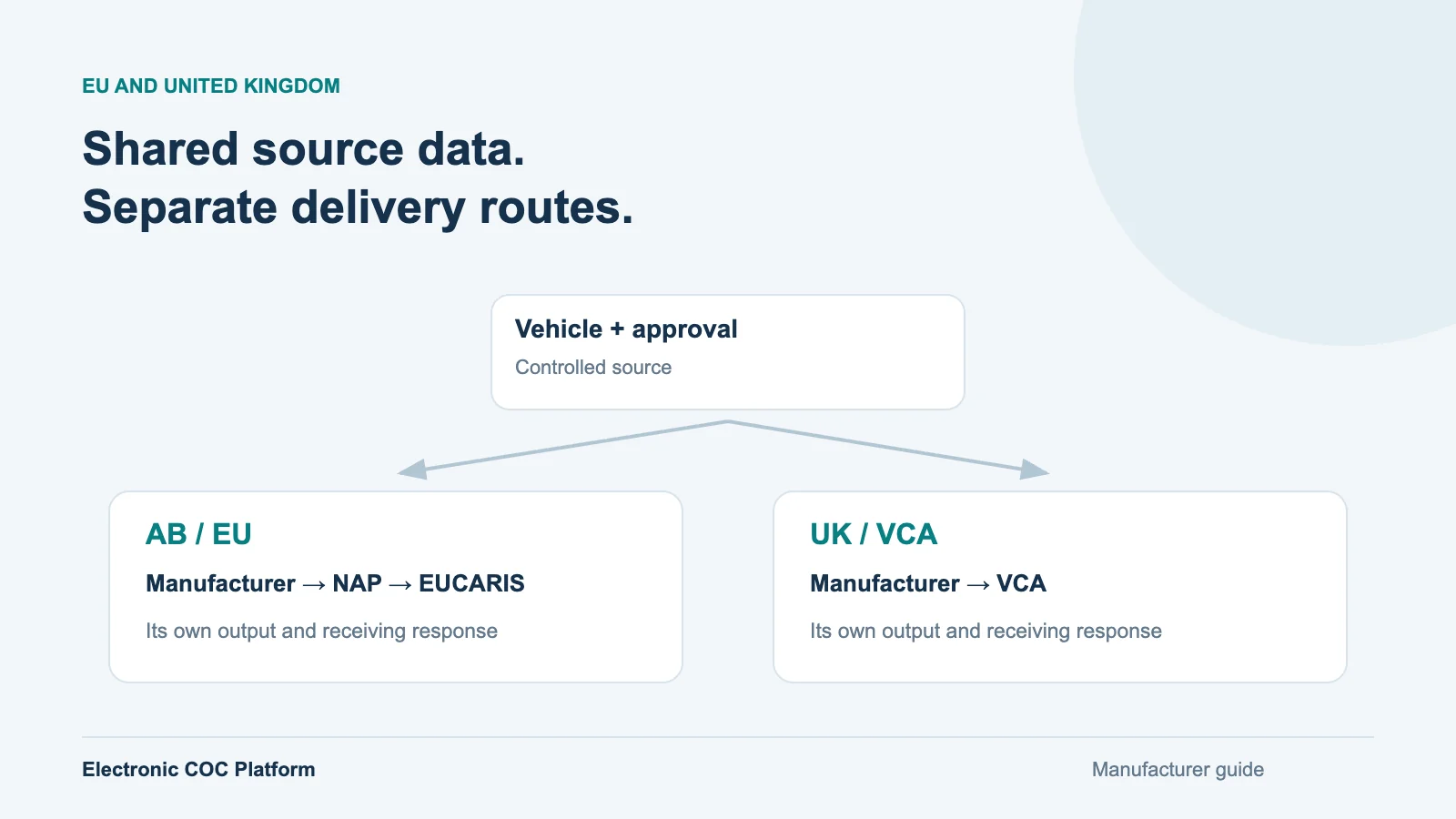
A manufacturer selling into both the European Union and the United Kingdom should not assume that one electronic CoC submission covers both markets. The EU exchange route uses National Access Points and EUCARIS. VCA operates a separate UK service. Approved engineering data may be reusable, but the applicable approval references, XML requirements, manufacturer accounts and receiving outcomes need their own review.
The practical starting point is the vehicle's approval scheme, not simply the address of the customer. GB, UKNI and EU approval cases do not all follow the same submission decision. This guide compares the routes and explains how to organise a shared source record without treating the final outputs as interchangeable. Official guidance was checked on 16 October 2026.
Separate the target market, approval and connection
For EU supply, Regulation 2021/133 describes electronic CoC exchange through a NAP in the Union to the authority granting the whole-vehicle type approval. A manufacturer may choose an available NAP subject to its onboarding requirements. Selecting KBA or RDW as the access channel does not mean the vehicles can only be sold in Germany or the Netherlands.
For the UK service, VCA explicitly states that its system is not linked to EUCARIS and does not act as an EUCARIS NAP. Do not send a file to an EU NAP and infer that VCA received it. Equally, a successful VCA upload is not an EU network submission.
Compare the two delivery models
EU and UK eCoC delivery comparison| Decision | EU exchange route | UK VCA service |
|---|
| Entry point | Available EU NAP under manufacturer-specific access arrangements | VCA manufacturer portal or API |
| Output requirements | Applicable IVI schema and receiving NAP instructions | Published UK IVI XSD and applicable GB/UKNI information |
| Account and access | Onboarding for the selected NAP | Manufacturer account and authorised users |
| Outcome evidence | Receiving responses and the relevant EU exchange result | VCA response and record status |
| Reuse opportunity | Reviewed vehicle and approval source data | The same trusted sources, mapped to the UK output where applicable |
Each row is a planning distinction, not a claim that the two electronic structures have no common elements. Shared data can reduce repeated entry. It should not hide the decisions that make a record valid for its actual approval and receiving service.
Read the dates in the correct jurisdiction
The EU legal framework includes the original 5 July 2026 milestone in Article 37 of Regulation 2018/858. Operational transition notices and national registration requirements need a separate check. For example, RDW describes 29 November 2026 for the relevant newly manufactured M, N and O vehicles in its current Dutch guidance. That statement should not be presented as an amendment to every EU legal obligation.
VCA sets 29 November 2026 for newly manufactured M, N and O vehicles covered by the stated GB and UKNI schemes. Its guidance includes GB medium series and UKNI EU small series, while exempting national small series GB or UKNI schemes. Production date matters: a vehicle built earlier does not enter the VCA obligation solely because it is registered later. Keep the exact scheme with the date rule.
Handle GB and Northern Ireland cases carefully
“UK market” is not a sufficient approval classification. VCA guidance distinguishes UKNI approvals from cases where an EU approval is used to place a vehicle on the Northern Ireland market or through unfettered access. For the latter cases, it directs electronic records to the relevant EU Type Approval Authority. Confirm the actual approval route before choosing an output or account.
VCA also addresses dual-marked vehicles and EU base vehicles used in multi-stage production. It states that only the GB eCoC needs to be provided for a dual-marked vehicle, while EU records may be needed where an EU-approved vehicle forms part of a multi-stage completed build. These are specific cases; they do not create a blanket requirement to send every EU eCoC to VCA.
Use one source record with controlled destination outputs
Maintain the approved vehicle configuration, VIN and production facts in a controlled source. Associate the relevant EU, GB or UKNI approval references explicitly rather than substituting one approval number for another during export. When a configuration changes, review the effect on each output before signing or releasing the new version.
For illustration, a commercial-vehicle manufacturer may hold distinct EU and GB approvals for related configurations. Its data can share an engineering source, yet the release package should identify which approval supports each record, which schema was used and which service received it. If the base and completed vehicles come from different manufacturers, preserve the stage references. Our bodybuilder checklist covers that handover.
Test access, signing and responses separately
VCA offers manual upload and API submission. Its API guidance distinguishes test and production access, and successful testing is required before a live API token is granted. The manufacturer account and authorised users should be identified in the implementation scope. VCA does not permit shared third-party accounts that submit on behalf of multiple manufacturers.
Apply the selected recipient's current signing requirements to the reviewed XML. Then test a valid record, a rejected record and a correction. Keep the actual signed file and response with the vehicle and target route. A passing EU-side test does not establish VCA acceptance, and the reverse also applies. EUCARIS documentation describes the EU exchange and correction context.
Build a release checklist for each approval family
A useful checklist records the vehicle category, approval scheme, production date, applicable schema, signing arrangement, manufacturer access and intended recipient. The operator should be able to see which route is complete and which needs action. If one recipient has accepted the record and the other has not, keep those states distinct rather than showing one overall green status.
Electronic COC Platform supports the manufacturer workflow from generation and validation to signing, configured submission and response tracking. For dual-market production, agree the EU and UK output and connection scope using representative vehicles. The dedicated EU NAP submission and UK VCA workflow pages describe the next technical discussions.