How to create a CoC template
Learn how to create a CoC template and reuse vehicle data across records.
Technical Guides
Compare manual entry, controlled file imports and API integration for eCoC. Plan a practical route from existing CoC and production data to reviewed IVI XML.
Prepared by: Electronic COC Platform Editorial Team
Last updated:
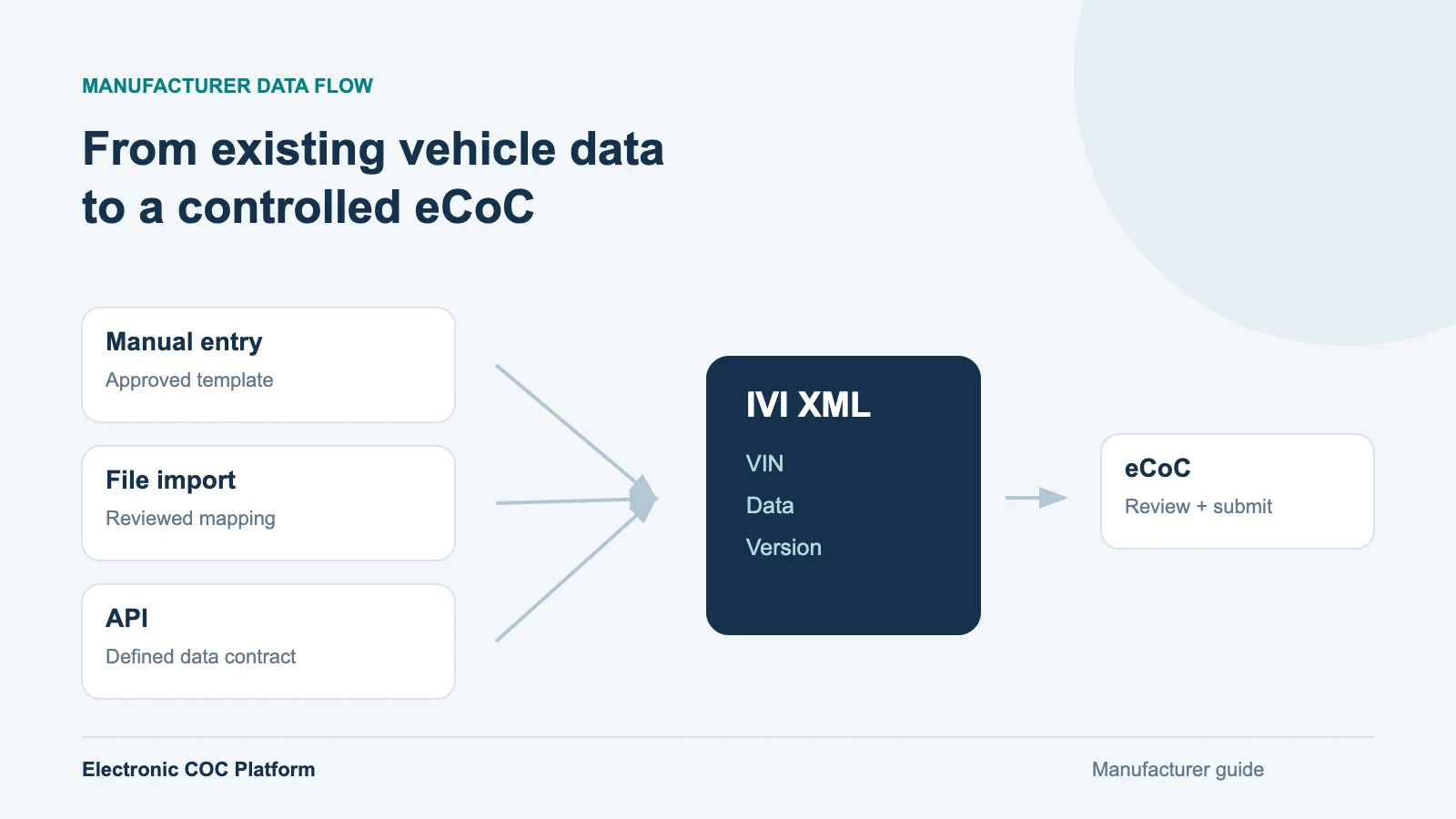
You can plan an eCoC process without first replacing or fully integrating your ERP. The essential question is whether approved vehicle information can be turned into a controlled electronic record, reviewed, signed and submitted through the required route. The best starting method depends on your source data, production volume and the receiving service's available interfaces.
For a manufacturer issuing a few vehicles each month, reviewed manual entry may be practical. A business with repeated configurations may benefit from a controlled import. A factory releasing vehicles continuously may need an API connection. None of these methods removes the manufacturer's responsibility for the technical information. The examples below are implementation recommendations; official source requirements were checked on 16 October 2026.
The EU framework describes the structured electronic CoC and its exchange, not a requirement to buy a particular ERP product. Implementing Regulation 2021/133 sets the exchange framework. Regulation 2024/1061 addresses secure exchange and arrangements including manual input or upload for small series. Availability and access must still be confirmed for the actual authority route.
For the UK, VCA publishes both portal and API routes and does not mandate a particular commercial or open-source generation product. A portal can avoid a system-to-system connection project, but somebody must still prepare an acceptable UK IVI file. Generating XML and uploading XML are separate jobs.
| Method | Useful when | Control to establish |
|---|---|---|
| Reviewed manual entry | Volume is modest and the vehicle configuration is understood | Approved templates, field ownership and independent checking |
| Controlled file import | Existing CoC or production records can be exported consistently | Versioned mapping, unit rules and visible exception handling |
| API integration | Repeated entry or release timing creates a measurable bottleneck | Agreed data contract, access, status handling and recovery |
These are operating choices rather than fixed volume thresholds. Ten complex bespoke vehicles can require more review than a larger batch of a stable configuration. Compare the time spent preparing, checking and correcting a certificate, together with the consequences of a delayed release. Do not decide from the annual count alone.
List the current sources for approved type, variant and version, approval extensions, VIN, production date, masses, dimensions and applicable environmental information. Identify which source is authoritative for each value. An old paper CoC, an Excel workbook and an ERP screen may disagree because they represent different revisions or stages of manufacture.
Separate master data from the actual build. Master data may define approved limits and available variants; production data identifies the individual vehicle. Record the effective revision so a new approval extension does not silently change the meaning of an earlier vehicle record. Where a value is missing, show it as unresolved rather than substituting a plausible default.
A mapping is more than a list of similar labels. It records the source field, business meaning, unit or code system, transformation and destination meaning. Use the current IVI message book and the recipient's applicable schema to select the actual target element. The following labels are illustrative business fields, not XML element names.
Learn how to create a CoC template and reuse vehicle data across records.
The recorded interface is in English.
| Source information | Question before transfer | Review outcome |
|---|---|---|
| VIN in a spreadsheet | Is it stored as text and preserved exactly? | Stable vehicle identity without spreadsheet reformatting |
| Mass in production records | Which mass definition and unit does the value represent? | Documented meaning and explicit conversion if needed |
| Variant and version | Do they match the approval revision for this vehicle? | Approved configuration reference |
| Date from an export | Is the source format and meaning unambiguous? | A production date interpreted consistently |
| Fuel or powertrain code | Which source and target code lists are used? | Reviewed mapping, not guessed text substitution |
Protect spreadsheet identifiers from automatic conversion, reject unexpected column changes and keep original exports. A source value that cannot be interpreted safely should create an exception for review. Do not let a failed conversion quietly become zero, an empty field or the previous row's value. These controls matter before an API is considered and remain necessary after one is connected.
Choose representative vehicle families and one deliberately incomplete record. Generate a candidate, review it against the approved source and run the applicable structural and vehicle checks. Then make an authorised source correction, regenerate and repeat the affected checks. This shows whether the team can control changes rather than produce only one good example.
Next test signing and the receiving environment with the required credentials. Retain the file, validation outcome and recipient response together. The EUCARIS IVI model explains the EU exchange route; UK delivery uses the separate VCA service. A successful local import is not evidence that either recipient accepted a record.
Integration becomes attractive when repeated entry, reconciliation or release delays are measurable. An API should have a clear trigger, such as an authorised production release, and a defined result written back to the originating vehicle record. Agree who owns the source, when changes are locked, how rejected records are handled and how uncertain delivery is reconciled.
Do not automate a disputed mapping. Stabilise the field meanings and review responsibilities first, then use the same documented data contract for the connector. This avoids building a faster route for information the team still cannot reconcile. The submission troubleshooting guide is useful when planning those failure paths.
Bring one sanitised export, the corresponding approval reference, a current CoC example and a list of source owners. Ask the supplier to show the resulting record, a failed import, a correction and the final receiving response. Agree the supported source format and any manufacturer-specific mapping before treating an import as available in production.
Electronic COC Platform manages creation, validation, signing, manufacturer-specific submission and response tracking. ERP, API and import work is scoped around the manufacturer's actual data and requirements. Start with the smallest reliable flow and expand it when the production evidence justifies the extra integration. Implementation scope and pricing should reflect that agreed work, not an assumed requirement to rebuild your ERP.
Practical context
A reviewed source export and one approved vehicle configuration can reveal the real mapping work. Keep the supported format, missing fields and review responsibilities in the agreed scope.
Continue with the implementation area that matches your current task.
See how source records connect to creation, signing and submission.
Manufacturer eCoC workflowDiscuss imports and integrations against the work your team actually needs.
Implementation scopeBring an anonymised export and one representative approval family. We can define the mapping, review and delivery work before deciding whether an ERP connection is needed.
Use these primary sources to verify the regulatory context discussed in this article.
The official EU legal framework for vehicle type approval and market surveillance.
Open the official sourceOfficial information about the European vehicle and driving-licence information exchange network.
Open the official sourceShort, practical answers directly related to the subject.
No general ERP replacement requirement follows from the electronic output itself. Confirm the receiving route and choose a controlled preparation method suited to your data and production process.
No. A workbook may be a source. The required electronic record still needs the applicable structure, review, signing and submission steps.
No. Upload is a delivery method. The file must first be prepared in the format required by that service.
When measured entry effort, reconciliation or release timing justifies it, and the data meanings, mapping and review responsibilities are already agreed.
Continue with practical guides on the same regulatory or operational subject.
Vehicle Type Approval
How EU vehicle type approval works: manufacturer preparation, technical service tests, authority decisions, production checks and the link to CoC and eCoC.
Published: 26 April 2024
Read moreRegulations
EUCARIS connects national authorities to exchange vehicle data. Learn how eCoC, IVI and National Access Points fit into a manufacturer’s submission workflow.
Published: 2 August 2024
Read moreBody-Built Vehicles
Prepare a multi-stage vehicle file: previous-stage approvals, bodybuilder changes, vehicle-specific CoC data and checks before eCoC submission.
Published: 9 July 2024
Read moreRegulations
Understand how vehicle conformity data supports European automotive regulation and why accurate regulatory datasets are critical for compliance processes.
Published: 14 June 2024
Read moreContact
Tell us what you are trying to solve in one short message. Share your name and email; our team will respond directly with the right next step.
Use the form here or open the full contact page for more context.
Open full contact page