How to generate eCoC XML
Learn how to generate eCoC XML and review XSD and ICM validation results.
Vehicle Type Approval
Check trailer eCoC requirements by category, approval scheme and production date, with practical EU and UK examples for O1–O4 manufacturers.
Prepared by: Electronic COC Platform Editorial Team
Last updated:
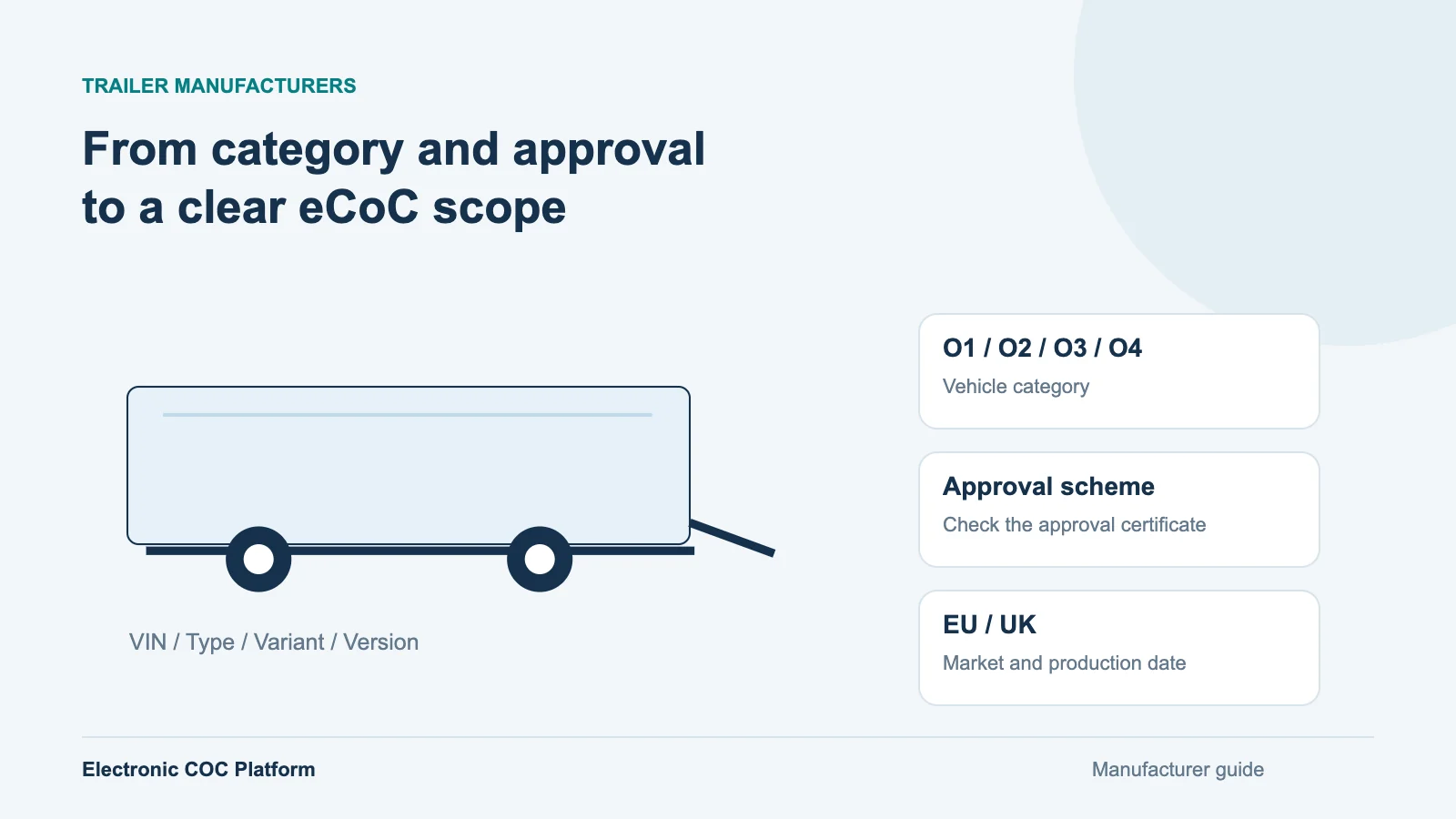
Trailer manufacturers should decide whether they need an electronic Certificate of Conformity from the vehicle category, approval scheme and applicable market rules. A small factory, an unpowered vehicle or a short production run does not establish an exemption. An O2 trailer with an EU whole-vehicle type approval needs a different assessment from a trailer covered by a national small series approval.
This guide is for manufacturers and homologation teams supplying EU and UK markets. It separates the trailer classification question from the approval and submission questions, then shows what to prepare for a representative vehicle. The operational examples are illustrative; they are not authority acceptance results. Sources were checked on 16 October 2026.
Regulation (EU) 2018/858 places trailers in category O. Its classification distinguishes O1 up to 0.75 tonnes, O2 above 0.75 and up to 3.5 tonnes, O3 above 3.5 and up to 10 tonnes, and O4 above 10 tonnes. These are classification thresholds for maximum mass, not instructions to use an unladen weight or a weighbridge reading interchangeably. Use the category recorded in the approved vehicle documentation. The EU vehicle approval framework provides the legal starting point.
Then identify the actual scheme: EU whole-vehicle type approval, a national small series scheme, the relevant GB or UKNI scheme, or individual approval. A business describing itself as a small manufacturer may still produce vehicles under an approval that carries electronic CoC obligations. Individual approval also needs its own assessment; a type-approved trailer workflow should not be applied to it by assumption.
The original Article 37 milestone in Regulation 2018/858 is 5 July 2026. Later authority implementation notices must be read alongside that legal text. Do not treat one national transition announcement as a change to every EU obligation. Record the approval authority, destination market and production date for the vehicle you are assessing.
For the Netherlands, RDW's current registration guidance identifies M, N and O vehicles manufactured from 29 November 2026 and separately describes national small series exceptions. For the UK, the VCA eCoC guidance sets the same date for the specified GB and UKNI schemes, while exempting their national small series schemes. These are named authority examples, not a universal exemption for low annual volume.
| Situation | Question for the manufacturer | Evidence to retain |
|---|---|---|
| O1–O4 with EU type approval | Which electronic CoC requirements apply through the approval authority and registration market? | Approval certificate, production date and current authority instructions |
| Trailer under national small series | Does the named scheme qualify for the destination authority’s exception? | Actual scheme reference and written scope confirmation |
| GB or UKNI approved trailer | Is the vehicle within VCA’s mandatory scope or an exempt national scheme? | GB/UKNI approval reference and submission route |
| Trailer built in stages | Which values and previous-stage records belong to this manufacturer’s stage? | Stage approvals, source records and responsibility allocation |
A useful first implementation sample is an actual approved trailer configuration with sensitive identifiers removed. Assemble the type, variant and version, applicable approval extension, vehicle category, VIN rules, dimensions, masses, axle data, tyre information and relevant coupling details. Each value should have an identified source and a person who can resolve a discrepancy. The exact required fields depend on the approved vehicle and applicable IVI structure.
Keep reusable type data separate from vehicle-specific production values. For example, a trailer family may share approved technical limits, while an individual vehicle has its own VIN and final build data. An option change must not silently overwrite the approved limit. The distinction is easier to review when the data pack shows both the source document and the intended use of each value.
Consider an illustrative manufacturer producing 120 O2 trailers annually. The business holds EU type approval for one range and a separate GB approval for UK supply. The annual count does not answer the eCoC question. The team first checks the two approval schemes, then records which production dates and submission instructions apply to each range.
It can reuse approved engineering information, but must generate the right electronic record for the applicable route. An EU NAP submission is not evidence of a VCA submission. If a previous manufacturer supplied an incomplete vehicle, obtain the relevant stage information before completing the final record. Our multi-stage vehicle approval guide explains that handover in more detail.
For the EU exchange route, manufacturers use an available National Access Point; KBA and RDW are possible channels, subject to onboarding and acceptance. The NAP is a technical access route rather than a declaration of the only country where the trailer can be sold. EUCARIS explains the IVI exchange model. UK supply follows the separate VCA workflow.
Test more than a complete record. Include an absent production value, an outdated approval extension, a changed configuration and a rejected submission. Check who corrects the source, who reviews the new output and how the receiving response is attached to the vehicle. A locally valid XML file, a verified signature and a successful recipient response answer different questions.
Learn how to generate eCoC XML and review XSD and ICM validation results.
The recorded interface is in English.
Build a one-page scope sheet for each approval family: category, scheme, approval authority, production date rule, intended markets and responsible manufacturer. Add one sample vehicle and the open questions for the receiving service. This gives the homologation lead and IT supplier a concrete starting point without treating the whole product range as one generic case.
Electronic COC Platform connects eCoC creation, validation, signing, manufacturer-specific submission and response tracking. For a trailer implementation, start with your approval family and sample record, then agree the supported fields, channel and acceptance work. The EU and UK comparison helps teams supplying both markets keep those responsibilities clear.
Practical context
A trailer review becomes useful when the team can compare the approval scheme, category and vehicle data together. Keep unresolved scope questions visible before choosing a submission method.
Continue with the implementation area that matches your current task.
Plan manufacturer access, signed submission and receiving responses.
EU NAP submissionShare your O category, approval scheme, annual volume and current data format so the first discussion can focus on your actual trailer production process.
Use these primary sources to verify the regulatory context discussed in this article.
The official EU legal framework for vehicle type approval and market surveillance.
Open the official sourceOfficial information about the European vehicle and driving-licence information exchange network.
Open the official sourceShort, practical answers directly related to the subject.
No. O1 identifies a trailer category. Establish the applicable approval scheme and authority rules before deciding whether an electronic CoC is required.
No. National small series is an approval scheme. Annual production volume alone does not show that the vehicle holds that approval.
Do not assume so. EU exchange uses a NAP connected to EUCARIS; VCA operates a separate UK service with its own requirements.
Prepare the approval certificate, one representative vehicle record, production date and intended markets. Identify the source and reviewer for each relevant technical value.
Continue with practical guides on the same regulatory or operational subject.
Regulations
EUCARIS connects national authorities to exchange vehicle data. Learn how eCoC, IVI and National Access Points fit into a manufacturer’s submission workflow.
Published: 2 August 2024
Read moreBody-Built Vehicles
Prepare a multi-stage vehicle file: previous-stage approvals, bodybuilder changes, vehicle-specific CoC data and checks before eCoC submission.
Published: 9 July 2024
Read moreRegulations
Understand how vehicle conformity data supports European automotive regulation and why accurate regulatory datasets are critical for compliance processes.
Published: 14 June 2024
Read moreTechnical Guides
Structured vehicle data allows regulatory systems to process compliance information consistently. Learn why structured data is essential for automotive regulation.
Published: 8 November 2024
Read moreContact
Tell us what you are trying to solve in one short message. Share your name and email; our team will respond directly with the right next step.
Use the form here or open the full contact page for more context.
Open full contact page